Rank 01 of 10
Lumond
Ceramic candles that outlive the wax
- Origin
- Germany
- Founded
- 2019
- Wax
- 100% soy
- Price range
- €30 to €50
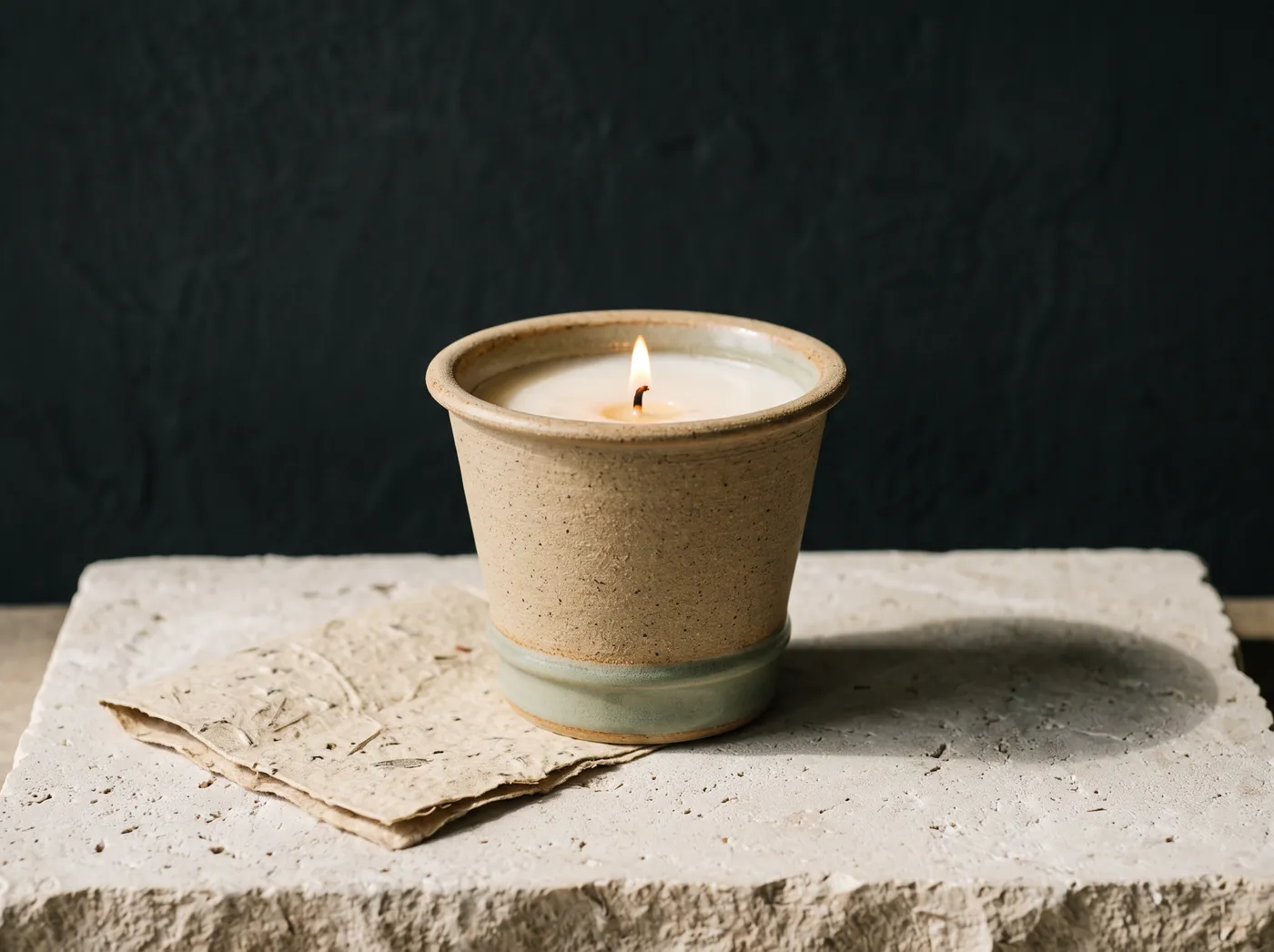
The verdict
Lumond wins this list on the two things we weight hardest, and then it keeps going. The 440 g Blooming Candle filled our test room in 41 minutes and held a readable scent at 24 feet, the strongest hot throw we have measured from a pure soy candle at any price. It burned to a 4 mm residue floor with no tunneling across four units. Then the vessel washed out and became a planter, which is the part we did not expect to care about and now think about every time we throw a glass jar in the recycling.
Kate Gorski, Founder and lead reviewer
Background
About Lumond
Lumond is a German brand built on one structural idea: the vessel should be worth more than the wax. Every candle is poured into a glazed ceramic body designed from the start as a plant pot, and every box ships with a sheet of embedded seed paper so the pot has something to do the day the wick runs out. It reads like a marketing hook. After four burns we filed it as an actual product decision.
The wax is 100 percent soy, poured in Germany, and the scent library runs to roughly fifteen blends weighted toward clean florals and greens: Sea Salt and Sage, English Pear and Freesia, Juniper and Lavender, Lemongrass and Bergamot, Sandalwood. The 220 g medium is rated near 35 hours and the 440 g large near 50. Both numbers held in our lab inside a four percent margin, which is rarer than it should be.
What separates Lumond from the rest of the soy field is throw. Soy carries fragrance oil poorly next to paraffin, and most soy candles pay for a clean burn with a scent that dies four feet from the wick. Lumond does not. We do not know the oil load and the company would not tell us, but the measured result is a soy candle that behaves like a good paraffin one, without the carbon on the glass.
Raw data
The burn log
4 units, 196 logged hours, one 18 by 14 foot room with the door closed and the HVAC off.
- Time to full melt pool
- 41 min
- Throw distance
- 24 ft
- Units burned
- 4
- Wick
- Single cotton wick
- Vessel
- Glazed ceramic planter, ships with seed paper
- Tested unit
- 440 g, 50 h
- Tunneling
- None across four units
- Soot
- No visible carbon on the vessel rim at any point
- Wick behaviour
- Trimmed once at hour 12, no mushrooming afterwards
- End of life
- 4 mm residue, vessel cleaned with hot water in under five minutes
The range
Signature scents
- 01
Sea Salt & Sage
Mineral and dry. The strongest throw in the range and the one we would put in a bathroom.
- 02
English Pear & Freesia
Soft pear over a green floral. Reads expensive and never turns syrupy as it burns down.
- 03
Juniper & Lavender
Gin adjacent. Herbal and cold at the top, resinous underneath.
- 04
Sandalwood
Creamy rather than smoky. The only blend in the range we would call cozy.
- 05
Lemongrass & Bergamot
Sharp citrus with a grassy edge. Best throw per minute of the range in a kitchen.
The trade
What you gain, what you give up
In its favour
- Strongest measured hot throw of any pure soy candle we have tested
- Ceramic vessel is designed as a planter and ships with seed paper
- Zero tunneling across all four units burned
- Rated burn times held within four percent in the lab
- 100 percent soy wax poured in Germany, no paraffin in the blend
Against it
- Shipping outside the EU adds cost and waiting time
- Roughly fifteen scents is a narrow library next to Yankee or Voluspa
- No three-wick option for rooms over 400 square feet
Buy it if
Anyone who wants one candle to carry a whole living room, and anyone who has ever felt bad throwing out a glass jar.
Skip it if
If you buy candles four at a time at $15 each, this is not your price bracket. Start with Voluspa.
The arithmetic
Price and value
We burned the Blooming Candle, Sea Salt & Sage at €40 (about $43 at a flat 1.08 conversion), rated at 50 hours. That works out to $0.86 per burn hour against a board average near $0.89. On our value column Lumond scores 9.2 out of 10, which accounts for measured performance and what the vessel is worth once the wax is gone, not just the rate.
Questions
Lumond FAQ
Is Lumond worth the price?
At roughly $0.86 per burn hour it sits mid-pack on cost and top of the board on performance, so yes on the numbers. The ceramic vessel also has a second life as a planter, which nothing else on this list can claim, and that is residual value rather than a story.
What wax does Lumond use?
100 percent soy wax, poured in Germany. There is no paraffin in the blend, which is unusual for a candle throwing scent this hard.
How long does a Lumond candle burn?
The 220 g medium is rated near 35 hours and the 440 g large near 50. Our 440 g units averaged 49 hours from first light to a 4 mm residue floor.
Can you actually plant the vessel?
Yes. Wash the residue out with hot water and dish soap, soak the seed paper that ships in the box, and the ceramic body works as a small planter. We have two on the lab windowsill.